How to Choose an Artificial Intelligence Agency in 2026
Choosing an Artificial Intelligence Agency: A Governance-First Guide for CEOs
About Rebecca Lloyd
I'm Rebecca Lloyd, founder of Growth Architect and a Fractional CMO. I work with founder-led technology businesses on strategic marketing, GTM systems, executive authority and AI-enabled growth, connecting marketing strategy, AI implementation, sales pipeline visibility and commercial growth.
Executive Summary
Choosing an artificial intelligence agency in 2026 requires CEOs to evaluate governance, technical capability and measurable business outcomes — not simply the technology an agency can deploy. Before appointing a provider, assess what data its AI systems can access, what actions they can take, where human approval is required and who is accountable when something goes wrong. Compare agencies on their ability to demonstrate risk controls, incident response, system integration and commercial return on investment. Growth Architect's AI Blast Radius Framework, Shadow Employee Model, War Games Test and AI Trust Grid provide a structured approach to evaluating providers and deciding whether to outsource, build internally or adopt a hybrid model.
An artificial intelligence agency helps organisations design, implement, integrate and govern AI systems, agents and automated workflows. CEOs choosing one should assess more than technical capability. The strongest providers can demonstrate clear governance, controlled system access, human accountability, auditability, measurable commercial outcomes and a credible incident-response model.
Whether you're considering an artificial intelligence automation agency, an artificial intelligence marketing agency or a broader AI consultancy, the fundamental question is the same:
What will its AI be allowed to do inside your business, and who remains accountable when it does it?
As AI moves from generating answers to taking actions across business systems, choosing an agency is becoming a commercial architecture decision, not simply a technology procurement exercise.

What does an artificial intelligence agency actually do?
An artificial intelligence agency is a specialist provider that helps businesses apply AI to workflows, systems, customer interactions, data and decision-making.
Different agencies specialise in different areas.
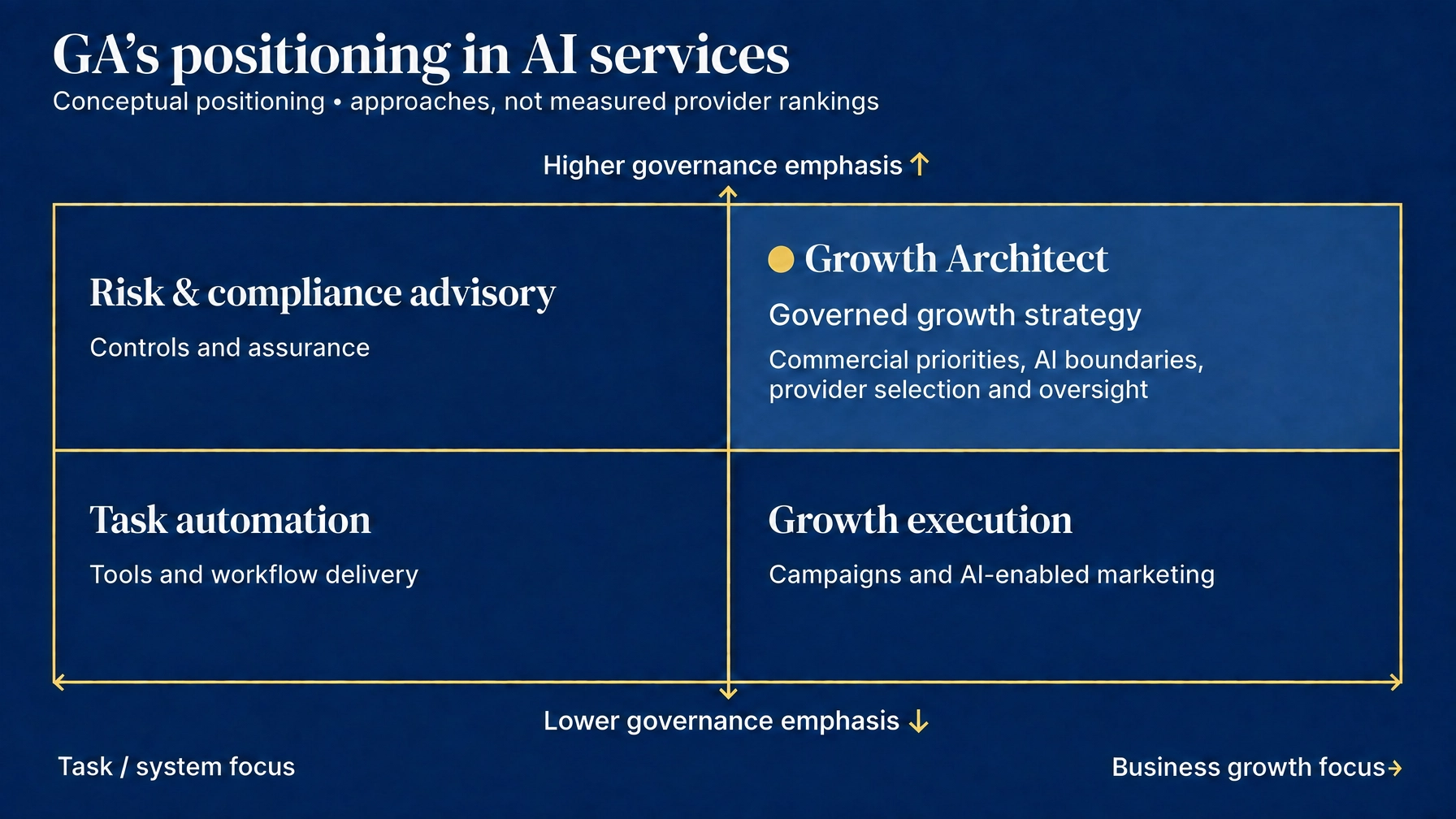
An artificial intelligence automation agency may concentrate on operational workflows, integrations and AI agents. An artificial intelligence marketing agency may focus on research, content, customer journeys, personalisation or marketing operations. A broader AI consultancy may work across strategy, enterprise systems, data and governance.
Growth Architect sits in the upper-right quadrant: commercial growth strategy + AI governance—helping the CEO decide where AI belongs, what authority it receives and how implementation should be overseen.
A capable agency should be able to address three interconnected layers:
Architecture and governance: Where AI operates, what data it can access, what actions it can take and where human approval is required.
Build and integration: How models, agents and workflows connect with your CRM, ERP, knowledge systems, marketing platforms or other infrastructure.
Adoption and change management: How your people work with AI, who supervises it and where human judgement remains essential.
The NIST AI Risk Management Framework developed by the US National Institute of Standards and Technology, supports this broader view. Its four functions (Govern, Map, Measure and Manage) treat governance as an ongoing part of AI risk management rather than something added after deployment. NIST also calls for clearly defined responsibilities, ongoing monitoring and executive accountability for AI-related risk decisions.
That creates an important distinction when evaluating an agency:
Building the AI is only part of the job. Governing what it can do is part of the architecture.

How to Choose an Artificial Intelligence Agency for Business Automation
I use one overarching decision architecture rather than a collection of unrelated AI checks.
At its centre is the Growth Architect AI Blast Radius Framework.

It asks four questions:
Where will the AI operate? Which workflows, systems, datasets and customer touch-points will it enter?
What can it see, do or change? Is access read-only, or can it write data, communicate externally, modify records or trigger other systems?
What happens when something goes wrong? How quickly can unusual behaviour be detected and contained?
Who owns the response? What belongs to the agency, what belongs to you and who remains accountable?
The point isn't to eliminate every possible AI risk.
It is to understand how far the consequences of a failure are allowed to travel through your business.
That's the 'blast radius'.
This builds naturally on the governance principles in NIST's framework, which includes ongoing monitoring, documented accountability structures, human oversight and clearly differentiated responsibilities for human-AI configurations.
Treat AI agents like shadow employees
The operating principle underneath the Blast Radius Framework is what I call the Shadow Employee Model.
If an AI agent can access tools, customer information or operational systems and take actions without somebody manually executing each step, treating it as "just software" is no longer enough.
Treat it like an employee with:

A defined role.
A human manager.
Specific access permissions.
Explicit prohibited actions.
Performance expectations.
Escalation requirements.
You wouldn't give a new employee unrestricted access to production systems, customer records and public communications without oversight.
The same principle should apply to AI.
NIST's AI RMF Playbook specifically addresses human-AI configurations and recommends clearly defining human roles, responsibilities, delegated authority, oversight and monitoring.
This is where an agency's approach becomes revealing.
Ask:
Who manages this agent?
What is it explicitly prohibited from doing?
What requires human approval?
Can one failure cascade into other systems?
If the answers aren't clear, the governance architecture isn't clear either.
Why AI governance is now a board-level issue
AI capability is moving faster than governance maturity in many organisations.
Deloitte's global board research surveyed 695 board members and C-suite executives across 56 countries. Almost one-third, 31%, said their organisations were not ready to deploy AI, while its research also found AI becoming more prominent in board discussions.
Regulation is moving as well.
The European Commission's guidance on Article 50 of the EU AI Act confirms that transparency obligations for certain AI systems began applying on 2 August 2026. These include requirements affecting providers and deployers of AI systems in defined circumstances.
The exact legal obligations affecting an Australian organisation will depend on jurisdiction, sector and use case. But the commercial direction is increasingly difficult to ignore:
Businesses need to know where AI is operating, how it is controlled and who remains accountable.
That should influence which artificial intelligence agency you appoint.
For a deeper discussion of AI governance, see Agentic AI Governance: A CEO Playbook.
Put the agency through a War Games Test
Once you understand the blast radius, pressure-test it.
I call this the AI Agency War Games Test.

Instead of asking only:
"What can you automate?"
ask:
"In a realistic worst-case scenario, how could this go wrong commercially, and what happens next?"
Give the agency a plausible scenario.
An agent sends incorrect information to hundreds of customers. Confidential information is exposed. A workflow takes an action it wasn't supposed to take.
Then ask:
How would you detect it?
How quickly could you stop it?
What systems would remain exposed?
Who investigates?
Who handles remediation?
Who communicates with customers?
What is your responsibility versus ours?
What changes afterwards to prevent recurrence?
A credible artificial intelligence agency should be able to discuss failure as confidently as capability.
That doesn't make the agency pessimistic.
It demonstrates that they've thought beyond the demo.
Use the AI Trust Grid to compare agencies
Once you've tested the architecture, compare providers using the Growth Architect AI Trust Grid.

The artificial intelligence agency with the most impressive demonstration isn't automatically the provider best equipped to operate inside your business.
Trust isn't what an agency says about responsible AI. It's what its architecture allows AI to do.

What are the red flags when choosing an AI agency?
Be cautious when an agency:
Selects tools before understanding the business problem.
Promises "efficiency" without establishing a measurable baseline.
Cannot explain agent permissions.
Cannot show where human approval sits.
Treats audit logging as optional.
Doesn't disclose important third-party model dependencies.
Has no clear incident-response process.
Measures success by deployment rather than business outcomes.
Cannot identify who remains accountable for consequential AI actions.
If an agency cannot explain the guardrails around its AI, it hasn't finished explaining the solution.
Governance can also have an efficiency benefit. NVIDIA's SoL-Pi research explores how improving the harness around an AI agent can reduce repeated model turns, context replay and unnecessary inference work while preserving the information required to complete the task.
The broader CEO lesson is important:
The economics of AI depend on architecture, not just model choice.

Artificial intelligence agency vs building AI in-house

There isn't a universal answer.
An external agency may make sense when you need specialist capability faster than you can recruit it, lack internal implementation experience, or need help establishing architecture and governance before scaling.
Building internally may make more sense when AI is central to your competitive advantage, proprietary architecture matters, you have sufficient scale to employ specialist talent, or data and regulatory requirements favour tighter internal control.
For many founder-led and mid-market organisations, the answer may eventually be hybrid:
Use external expertise to accelerate architecture and implementation while deliberately transferring strategically important capability into the business.
Whatever model you choose, clarify ownership of data, prompts, workflows, documentation and governance artefacts before implementation.
How should you measure an artificial intelligence agency?
Deployment is not the outcome.
I would measure an AI engagement across three areas:
Commercial impact: revenue, margin, cost avoided, capacity created or cycle-time reduction.
Governance quality: error rates, incidents, detection time, human overrides, audit findings and escalations.
Adoption and trust: staff utilisation, appropriate human intervention, user confidence and reduction in repetitive work.
A 30% productivity improvement isn't necessarily valuable if errors, remediation costs or customer problems wipe out the gain.
The goal is controlled leverage: creating measurable business value without giving AI more operational authority than the value requires.
The CEO questions to answer before choosing an artificial intelligence agency
Before signing, make sure you can answer:
Where will AI operate?
What data can it access?
What actions can it take?
Where is human approval mandatory?
Who is accountable for each agent?
What is the realistic worst-case failure?
How quickly could it be detected and contained?
What is the agency responsible for after an incident?
What commercial outcome are we buying?
How will ROI be measured?
What are the ongoing operating costs?
What third-party providers are involved?
What capability should eventually sit internally?
If those questions don't have clear answers, you don't yet have enough information to make a defensible agency decision.
Choosing an artificial intelligence agency is ultimately a trust decision
AI agency selection is moving beyond model capability.
As AI systems become capable of taking actions inside business workflows, CEOs need to evaluate commercial value and operational authority together.
That's the logic behind the Growth Architect approach:
AI Blast Radius Framework defines the exposure.
Shadow Employee Model defines how agents operate.
War Games Test pressure-tests the architecture.
AI Trust Grid compares providers.
The question isn't:
"Who can give us the most AI?"
It's:
"Where should AI create leverage in this business, how much autonomy does that require, and what architecture keeps the upside greater than the exposure?"
That's a much stronger basis for choosing an artificial intelligence agency.
Download the AI Agent Risk Checklist: CEO Action Sheet
Before you shortlist an artificial intelligence agency, pressure-test the decision.
The AI Agent Risk Checklist: CEO Action Sheet gives you a practical executive worksheet for assessing:
Agent permissions.
Data access.
Human accountability.
Blast radius.
Incident response.
Vendor exposure.
Commercial value.
Governance readiness.
Use it with your leadership team or take it into your next AI agency conversation.
Listen to Marketing Insights for Tech CEOs on Spotify.