MSP Lead Generation in 2027. How to Build a Pipeline That Doesn't Rely on Inconsistent Referrals
MSP Lead Generation: How Australian MSPs Can Build a Pipeline Beyond Referrals
About Rebecca Lloyd
I'm Rebecca Lloyd, founder of Growth Architect and a Fractional CMO. I work with founder-led technology businesses on strategic marketing, GTM systems, executive authority and AI-enabled growth, connecting marketing strategy, AI implementation, sales pipeline visibility and commercial growth.
Executive Summary
MSP lead generation is a commercial resilience question before it is a lead volume question. Referrals prove your customers value your service, but they arrive on someone else's timing and rarely match the customers you want next. The aim is a reliable way of attracting the right buyers and helping them understand your value.
Effective marketing starts with the buying group and the psychographic drivers behind the purchase, not the services you want to sell. Your website then needs different experiences for buyers who are not ready to book a consultation.
The seven pillars in my benchmark report show where buyer leakage occurs, nd the 90-day sequence shows what to examine first. Marketing investment should then answer to qualified pipeline, not activity.
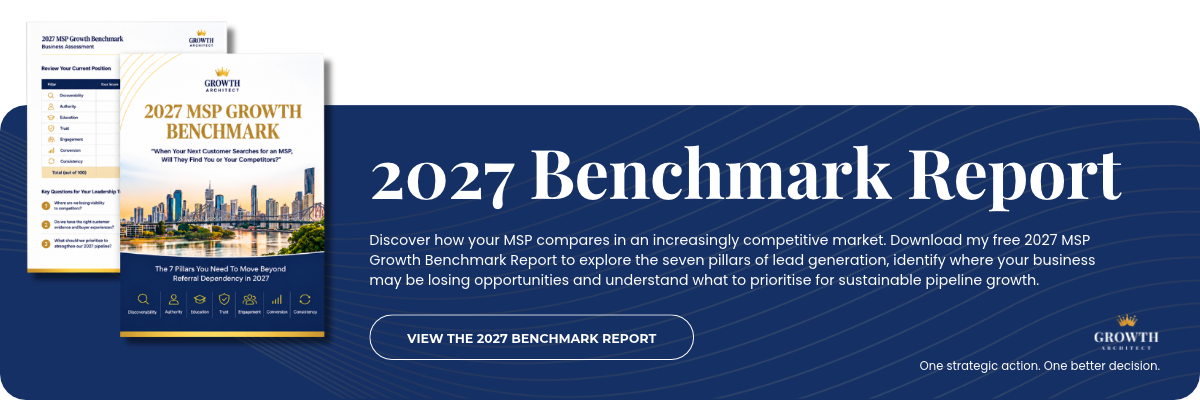
Access the 2027 benchmark report HERE
72% of MSPs rely on referrals to generate business....but only 43% have a qualified referral program.
If your MSP has built a successful business through referrals, that's a good indication that your customers value the service you provide and are prepared to recommend you to others. I wouldn't suggest abandoning a source of business that has already proven its value.
What I would question is whether referrals alone can support the next stage of your growth.
When someone recommends your MSP, they've already done some of the work of establishing trust. Your prospective customer arrives with a degree of confidence in your business because someone they know has endorsed you. But what happens when a potential customer doesn't have that personal recommendation?
They might discover your business through Google, LinkedIn, an AI-generated recommendation or an industry article. At that point, your website, content, customer evidence and leadership presence need to help them understand why your organisation deserves consideration.
If those elements aren't working together, you may have an excellent technical business that struggles to attract customers outside its existing network.
This is one of the challenges I examined in my 2027 MSP Growth Benchmark, which considers how managed service providers support buyer discovery, evaluation and engagement.
According to the ConnectWise 2026 MSP Marketing Report, 72% of surveyed MSPs identified referrals as a key business driver, yet only 43% had a formal referral programme.
There's clearly value in referrals, but there's also a commercial risk in depending on something you cannot reliably predict or control. You don't necessarily know when the next recommendation will arrive, whether the opportunity will suit your business or whether it will be sufficient to meet your growth targets.
For me, the objective of MSP lead generation isn't simply to attract more enquiries. It's to develop a commercially reliable way of attracting the right customers, helping them understand your value and giving them sufficient confidence to engage with your business.
Why MSP Lead Generation Needs to Move Beyond Product-First Marketing
One of the most common challenges I see when examining MSP marketing is how heavily providers lead with their products and technical capabilities.
There's often considerable value within an MSP's wheelhouse, but that value isn't always clearly articulated in its go-to-market strategy.
A typical MSP website might describe managed IT services, cybersecurity, Microsoft 365, cloud infrastructure, backup solutions and automation capabilities. All of these services may be relevant, but simply explaining what your technology does isn't necessarily helping a prospective customer understand why they should invest in it.
If your business focusses primarily on products and technical features, you're leaving your prospective customers to work out how those capabilities relate to their own commercial priorities.
And those priorities can vary considerably within the same buying organisation.
A CFO may be concerned about controlling operating costs, managing financial risk and understanding the return on technology investment. An operations manager may be looking for ways to reduce administrative work and improve productivity. An IT manager will probably want to understand integration, reliability and security, while the CEO may be evaluating whether the proposed investment supports the organisation's broader growth objectives.
They're all considering the same technology provider, but they're approaching the purchasing decision from different perspectives.
I believe this is where many MSPs have an opportunity to improve their marketing. Rather than beginning with the services you want to sell, begin with the people involved in buying them and the problems they're trying to solve.
What does your ideal MSP customer actually want?
Most MSPs can describe their ideal customer in terms of industry, business size, geographic location and technology requirements.
That's a useful starting point, but I don't think it provides enough information to build an effective lead generation strategy.
I want to understand what motivates the people making the purchasing decision. What are they concerned about? What are they trying to achieve? What would make them consider changing providers, and what evidence would give them confidence to recommend your business internally?
These are the psychographic drivers that influence how customers evaluate your services.
For example, telling a CEO that your MSP provides advanced automation capabilities may be technically accurate, but it doesn't necessarily explain the commercial value.
If you can demonstrate how automation could reduce repetitive administrative work, improve productivity and free employees to concentrate on higher-value activities, you're giving that CEO a business reason to explore the opportunity.
The underlying technology hasn't changed. What has changed is your ability to communicate its relevance to the customer.

This is particularly important because buyers are conducting considerable research before speaking with suppliers.
The 2026 APAC B2B Buyer Journey Research from Green Hat and 6sense found that 79% of surveyed buyers ultimately purchased from the vendor they preferred before speaking with sellers.
I think that's an important consideration for MSP CEOs. If prospective customers are forming preferences before your sales team has an opportunity to speak with them, your marketing needs to help answer their questions much earlier in the purchasing journey.
Your company's content should reflect the customers it wants to serve, the problems it wants to be known for solving and the evidence required to support purchasing decisions. Just as your sales team would if they were sitting across from the prospect.
Your MSP Website Should Be a Theme Park, Not Just a Brochure
I often use the analogy of a theme park (hats off to Daniel Priestley for this one! I heard him say it in a video a while ago and I've been quoting it ever since!) when explaining how businesses can create more engaging customer experiences.
When someone visits a theme park, they don't expect to find one ride that everyone has to enjoy.
Different visitors have different interests, preferences and levels of confidence. Some are ready for the biggest rollercoaster, others prefer something educational or entertaining, and some want to explore their surroundings before deciding what to do.
Your MSP's prospective customers are much the same.
Not everyone who arrives on your website is ready to book a consultation. Some are only beginning to recognise a problem. Others are comparing possible solutions, preparing a business case or gathering information to discuss with colleagues.
If your website offers little more than a description of your services and a Book a Consultation button, you're effectively offering every visitor the same ride.
That may work for someone who already knows they need a new IT provider, but it gives other prospective customers very little opportunity to engage with your business.
I'd encourage MSP CEOs to think about the different experiences their website could offer, particularly for buyers who aren't ready to speak with sales.
What would a theme park experience look like for an MSP?
I'd begin by considering the questions your ideal customers are asking at different stages of their purchasing journey.
For example, you might offer:
Interactive calculators that help customers estimate the potential cost of downtime, inefficient processes or technology investment.
Educational videos explaining business technology challenges in language that CEOs and non-technical decision-makers can understand.
Industry-specific case studies demonstrating how you've helped organisations address similar commercial problems.
Self-assessment tools that allow prospective customers to evaluate their current cybersecurity, productivity or IT arrangements.
Webinars and podcasts where your leadership team shares its expertise and explains how it approaches particular business challenges.
Practical guides and comparison resources that help customers understand their options and prepare recommendations for other members of their buying group.
I wouldn't recommend developing all of these simply to make your website appear more comprehensive. Each experience should have a purpose and contribute to helping the right customers make an informed purchasing decision.
A CFO might find value in a cost calculator, while an operations manager may prefer a video demonstrating how automation could improve productivity. An IT manager might engage with a technical assessment, and the CEO may want to understand your leadership team's experience and review customer case studies.
By providing different ways to engage, you're allowing prospective customers to explore the areas that matter most to them.
You're also giving your business more opportunities to demonstrate expertise before a sales conversation takes place.
That's what I mean when I suggest treating your website like a theme park. The objective isn't to entertain visitors for the sake of it. It's to create useful experiences that help different buyers understand your value and move towards a purchasing decision.
Why Your Website Experience Influences Whether Buyers Shortlist Your MSP
Consider what happens when a CEO begins researching managed IT providers.
They find two businesses through Google. Both appear technically capable, both offer similar services and neither has been personally recommended.
The first website is difficult to navigate. Most of the content describes technical services, and the CEO struggles to understand how those services relate to the challenges facing their organisation. Eventually, they find a contact form inviting them to arrange a consultation.
The second website explains the commercial problems it helps businesses solve. It includes relevant customer examples, educational videos and an assessment that allows the CEO to evaluate aspects of their current technology environment.
The CEO can also see the people behind the organisation, understand their approach and explore useful resources without immediately committing to a sales conversation.
I'd expect the second provider to have an advantage in that situation because it has made the evaluation process easier.
Of course, a well-designed website doesn't guarantee excellent service delivery. But the experience a prospective customer has when researching your business can influence their perception of your professionalism, expertise and ability to understand their needs.
If your website is confusing, difficult to navigate or overly technical, you may be introducing unnecessary doubt before anyone has spoken with your team.
I think MSPs sometimes underestimate how important this is for customers who aren't technically sophisticated.
Your prospective customer may understand that their business needs reliable technology, stronger security or more efficient systems without understanding the technical terminology used to describe those services.
Your marketing should help them make an informed decision, rather than requiring them to become technology experts before they can evaluate your business.
How to Stop Your MSP Disappearing Into a Sea of Beige
Another challenge I regularly see in technology marketing is what I describe as a sea of beige.
Many MSPs publish remarkably similar content about cybersecurity, cloud migration, productivity and emerging technology. These are all relevant topics, but the content often does very little to distinguish one provider from another.
The same messages appear across websites, LinkedIn pages and marketing campaigns, frequently without a clear connection to the organisation's ideal customers or commercial positioning.
If I removed your company name from your latest LinkedIn post and replaced it with a competitor's, would the content still make sense?

If it would, I'd question whether that content is doing enough to communicate your particular expertise and approach.
I don't believe the solution is simply to become louder or publish more frequently. Your business needs to demonstrate why its perspective, experience and capabilities are relevant to the customers it wants to attract.
Lead with the buyer's problem, not your product
Instead of publishing another generic article about the benefits of cloud technology, I'd encourage you to examine a specific problem your ideal customer is experiencing.
For example, a professional services firm may have employees spending considerable time transferring information between disconnected systems.
Your content could explain why that happens, how it affects productivity and what the organisation should consider when evaluating possible solutions.
You might then develop a video demonstrating a practical approach, a calculator to estimate the cost of inefficient workflows or a customer case study showing how you've addressed a similar problem.
This approach gives prospective customers a reason to engage with your expertise because you're discussing something directly relevant to their business.
It also creates opportunities for your CEO and technical specialists to demonstrate their thinking.
I place considerable importance on executive authority because prospective customers aren't only evaluating the technology you provide. They're also assessing the people, judgement and relationships behind your service.
Your technical team may have years of experience solving complex problems, but if that expertise isn't visible in your marketing, prospective customers may never discover what makes your business different.
MSP Lead Generation Requires Both Visibility and Conversion

Being found by prospective customers is important, but discoverability and lead generation aren't the same thing.
Your MSP might rank well in Google, publish regularly on LinkedIn or appear in AI-generated supplier recommendations. Those activities can help prospective customers discover your business, but they don't automatically create qualified sales opportunities.
A potential customer may visit your website and leave because they can't find evidence of your experience in their industry. Someone else might read an educational article but find no relevant next step. Another prospect may complete an assessment but never receive meaningful follow-up.
I think of these situations as buyer leakage.
Your business has successfully attracted someone's attention, but something in the customer journey has prevented that interest from progressing.
In November 2026, I examined Brisbane and Gold Coast MSP marketing through 28 Google searches, executive LinkedIn reviews and 12 detailed website examinations.
As part of that work, I developed a seven-category, 100-point framework to examine how effectively MSPs support buyer discovery, evaluation and engagement.
This was exploratory research rather than a statistically representative survey of Australian MSPs. Its value is in providing a practical way for business leaders to examine their own marketing and identify where potential opportunities may be lost.
The seven pillars of MSP lead generation
I believe these seven areas need to be considered together because weaknesses in one can reduce the effectiveness of investment in another.
For example, improving search rankings may bring more people to your website, but if those visitors can't understand your differentiation or find a useful next step, additional traffic may achieve very little.
Similarly, investing in educational content without understanding your ideal customer can attract an audience that isn't commercially relevant to your business.
I've explored the discoverability challenge in more detail in my article on AI Search Optimisation for CEOs, including how AI-generated answers are changing the way businesses may be discovered and evaluated.

However, I'd encourage MSP CEOs to look beyond whether their business appears in search results.
The more useful commercial question is whether the entire customer journey helps suitable buyers understand your expertise, build confidence and progress towards becoming a customer.
When Your MSP Lead Generation Isn't Working, Consider a Different Approach
One of the examples I often return to involves a technology client who had spent several months trying to engage a high-value enterprise prospect.
The usual emails and phone calls weren't producing a response.
We could have continued with the same approach and increased the frequency of contact, but I wanted to consider what would make the communication more relevant to the person we were trying to reach.
We developed a highly personalised video addressing the prospect's commercial challenges and explaining how the proposed solution could potentially deliver more than $7 million in value over three years.
That figure represented projected commercial value, not an outcome that had already been achieved.
Within two hours of sending the video, the prospect's executive assistant contacted us to arrange a meeting.
After approximately three to six months of unsuccessful outreach, we'd finally opened the door to a conversation. The engagement subsequently progressed into a deal.
You can read the personalised video case study here.
I share this example because it demonstrates how changing the experience or communication approach can make a difference when conventional activity isn't producing the desired result.
I'm not suggesting that every MSP should start producing personalised videos for every prospect. That would be expensive and impractical for many businesses.
What I would encourage you to consider is whether you're investing more effort in an approach that isn't working, when the underlying problem may require a different solution.
Innovation can begin with a simple conversation
Imagine your sales team contacts a prospective customer who explains that they're satisfied with their current IT provider.
A common response would be to thank them, record the conversation and arrange to follow up in six months.
There's nothing inherently wrong with that approach, but I think there's an opportunity to learn something more useful.
Your salesperson could ask:
If you ever considered changing IT providers, what's the one thing you'd want your current supplier to do differently?
The answer might reveal a frustration with response times, reporting, automation, communication or the commercial value the customer receives from their existing technology investment.
That information can help you understand what matters to prospective customers, identify possible gaps in the market and improve how you communicate your own services.
You might use the insight to develop an educational video, write an article, create a practical assessment or refine your service proposition.
Rather than producing content because your marketing calendar requires another post, you're using actual buyer concerns to guide what your business communicates.
I believe this is an important opportunity for MSPs as AI makes it easier to produce and distribute content at scale.
Technology can assist with research, production and personalisation, but it doesn't remove the need for commercial judgement or genuine customer understanding.
In fact, I expect the ability to recognise a customer's underlying problem, ask better questions and develop meaningful relationships to become increasingly valuable.
How to Build an Inbound Marketing Funnel for Your MSP
When I approach inbound marketing, I prefer to begin with the commercial outcome rather than the marketing channels.
Before deciding whether your MSP needs more SEO, LinkedIn content, advertising or webinars, I'd want to understand who you're trying to attract and what needs to happen before those customers are ready to engage.
Which industries and organisations represent your best opportunities? Who participates in the purchasing decision? What problems are those people trying to solve, and what evidence will help them decide whether your MSP is the right provider?
Once you've answered those questions, you can develop a customer journey that supports them.
For example, an MSP targeting accounting firms might identify workflow efficiency, cybersecurity and the challenges of managing technology across multiple offices as recurring customer concerns.
A prospective customer could discover an article explaining how disconnected systems affect productivity, watch a video exploring possible improvements and then complete a practical assessment of their current processes.
They might subsequently review a case study demonstrating how your MSP has addressed a similar challenge before arranging a conversation with your team.
Each experience should help the buyer understand something useful and develop greater confidence in your expertise.
I wouldn't insist that every interaction captures a lead immediately. Some content should be freely available because its purpose is to demonstrate your thinking and establish credibility.
Other experiences, such as detailed assessments, workshops or consultations, may provide an appropriate opportunity to begin a more direct relationship.
What matters is that these experiences are connected.
If your articles, videos, assessments and sales conversations all address different audiences or unrelated problems, you're creating marketing assets without necessarily creating an effective customer journey.
An inbound marketing funnel should make it easier for the right buyers to progress from discovering your business to understanding its value and deciding whether to engage.
Why Your MSP Needs a Go-to-Market Strategy, Not Just More Marketing Activity
I've worked with technology businesses where considerable time and money were being invested in marketing, but the individual activities weren't necessarily contributing to a shared commercial objective.
An SEO specialist might be concentrating on rankings, a social media agency producing regular posts and another supplier managing advertising. Meanwhile, the sales team is pursuing opportunities through its own processes.
Each specialist may be doing their job competently, yet the business may still struggle to generate the qualified pipeline it needs.
I often explain this using an airport analogy.
Imagine an airport with excellent pilots but no air traffic controller.
Each pilot may be highly capable of flying their aircraft, but someone still needs to coordinate movements, manage priorities and ensure everything operates safely and efficiently.
Marketing works in a similar way.
Your marketing specialists provide the Hands. They're responsible for the execution of SEO, content, advertising, website development, automation and other specialist activities.
The Head provides strategic direction. It determines which customers the business should target, how it needs to position itself, what commercial outcomes matter and how the individual activities should work together.
You need both capabilities, but they serve different purposes.
I think this distinction is particularly important for MSP CEOs evaluating whether to hire another marketing agency or invest in strategic marketing leadership.
A good agency can deliver excellent specialist work. However, someone still needs to take responsibility for ensuring that work contributes to the organisation's broader go-to-market objectives.
I've explored this further in Fractional CMO vs AI Marketing Agency: Which Delivers Better ROI for CEOs?.
Before investing in additional marketing execution, I'd encourage you to examine whether your business has the strategic direction, coordination and accountability required to make that investment effective.
What Commercial Results Can a Connected Marketing Strategy Produce?
In one engagement, I provided an outsourced marketing management function for a high seven-figure technology business that didn't have dedicated strategic marketing leadership.
The work involved coordinating branding, content, events, webinars, email marketing, sales collateral, contractors and executive personal brand development.
These weren't entirely new marketing disciplines for the business. The opportunity was to bring the activities together under a more coordinated approach that supported its commercial objectives.
Over 18 months, the engagement contributed to $1.5 million in qualified sales pipeline, while also strengthening the market presence of the company's spokesperson.
You can read the technology company pipeline growth case study.
I want to be clear that the $1.5 million represented qualified sales opportunities, not realised revenue.
Nevertheless, the example illustrates why I encourage CEOs to evaluate marketing according to its contribution to commercial opportunities rather than relying exclusively on measures such as content volume, impressions or follower growth.
Those indicators can be useful, but they don't tell you whether your marketing investment is attracting customers who are suitable for your business.
I'd be much more interested in understanding how your marketing supports qualified enquiries, sales progression and customer acquisition.

Treat Your Marketing Investment Like an Employee With KPIs
If you employed someone on a substantial salary, you'd expect to understand their responsibilities, how their performance would be measured and whether their contribution justified the investment.
Yet I regularly see businesses spending considerable amounts on marketing without applying the same level of commercial scrutiny.
They know how much they're paying for SEO, social media, advertising and content production, but they may struggle to explain how those activities contribute to qualified pipeline.
To me, that's rather like employing someone without clearly defining their role or assessing whether their work is helping the business.
I believe your marketing investment should have KPIs, just as your employees do.
That doesn't mean expecting every LinkedIn post or educational video to generate an immediate sale. Different activities influence customers at different stages of the buying journey, and not every contribution can be attributed precisely.
However, you should still be able to explain what each activity is intended to achieve and how you'll assess whether it's contributing to your commercial objectives.
Which MSP lead generation metrics should you measure?
I'd consider six connected areas:
Relevant visibility: Are you reaching the industries, organisations and decision-makers you want to attract?
Meaningful engagement: Are suitable prospective customers interacting with your content, assessments and educational resources?
Qualified enquiries: Are the opportunities entering your pipeline aligned with your ideal customer profile?
Sales progression: Are those opportunities advancing through your sales process?
Customer acquisition: How many suitable new customers are you winning, and what does it cost to acquire them?
Revenue contribution: What commercial value is your marketing helping to generate?
I'd also examine where prospective customers are dropping out of the journey.
If your website attracts suitable visitors but generates very few enquiries, you may have a conversion problem rather than a visibility problem.
If your marketing generates plenty of enquiries but very few qualified opportunities, I'd revisit your targeting, positioning and qualification process.
And if your sales team regularly loses opportunities to competitors, I'd want to understand whether buyers are receiving the information, customer evidence and reassurance they need to make a confident decision.
These situations require different responses.
Increasing advertising expenditure won't necessarily solve a conversion problem. Publishing more content won't automatically improve your positioning, and attracting more leads won't help much if those leads aren't commercially suitable.
The purpose of measurement is to understand where your growth constraint sits so you can make better decisions about where to invest next.
How Australian MSPs Can Improve Lead Generation Over the Next 90 Days
If you're planning your MSP's growth strategy for 2027, I'd encourage you to use the Christmas and New Year period to spend some time working on your business rather than simply in it.
For many CEOs, this is one of the few opportunities to examine the organisation's direction without the usual volume of operational demands.
Before committing to another year of marketing expenditure, I'd focus on three areas over the next 90 days.
Days 1–30: Understand your ideal customers and buying groups
I'd begin by examining which customers are most valuable to your business and which types of organisations you want to attract in the future.
Look beyond company size, location and industry to understand the commercial problems those customers are trying to solve.
Consider the different people involved in purchasing your services. What does the CEO need to know? What concerns the CFO? What evidence will the IT manager require, and what would make the operations manager confident in your approach?
I'd also review your existing customer relationships to identify where you've delivered the strongest outcomes, which customers are most profitable and what those organisations have in common.
Then compare those findings with your current marketing.
Does your website reflect the customers you actually want? Are you communicating the problems you're best equipped to solve, or are you still leading primarily with technical services?
This work should provide a clearer foundation for your positioning and lead generation strategy.
Days 31–60: Audit your visibility, credibility and buyer experience
Once you've clarified your ideal customers, I'd examine how easily they can discover and evaluate your business.
That includes reviewing your visibility through Google, AI search, LinkedIn and other relevant channels.
However, I wouldn't stop at discoverability.
I'd also want to understand what happens when someone finds your MSP.
Can prospective customers recognise your differentiation? Are there relevant case studies? Does your leadership team demonstrate expertise? Can different members of the buying group find information that addresses their particular concerns?
And does your website offer useful experiences for people who aren't ready to arrange a consultation?
This is where I'd apply the seven-pillar framework from my 2027 MSP Growth Benchmark to identify areas that may be weakening your customer acquisition process.
Days 61–90: Align your marketing investment with commercial pipeline
Once you understand your target customers and the weaknesses in your current customer journey, you'll be in a better position to decide where to invest.
You might need stronger SEO, more relevant educational content, better executive positioning, improved landing pages or a more structured approach to nurturing leads.
But I'd want those decisions to follow the diagnosis rather than precede it.
I'd also establish clear commercial KPIs and agree how marketing and sales will work together to attract, qualify and progress suitable opportunities.
Your marketing budget should support a coordinated go-to-market strategy with defined commercial objectives.
Otherwise, you risk entering another year of activity without resolving the underlying reasons your business isn't generating the pipeline it needs.
Frequently Asked Questions About MSP Lead Generation
How can an Australian MSP generate more qualified leads?
I'd begin by defining the customers your MSP wants to attract and understanding the different people involved in their purchasing decisions. From there, I'd develop clear commercial positioning, improve relevant search visibility and create educational content and customer experiences that help prospective buyers evaluate your services.
I'd also measure whether those activities are producing qualified opportunities, rather than simply increasing website traffic or enquiry volume.
What are the most effective MSP lead generation strategies?
The most effective approach will depend on your target market, competitive positioning, existing reputation and sales cycle.
Referrals, SEO, executive thought leadership, targeted outreach, educational content, case studies and interactive assessments can all contribute to lead generation.
I would focus on how these activities work together to support the customer journey, rather than assuming one marketing channel will solve every acquisition challenge.
How do you build an inbound marketing funnel for an MSP?
I'd build an inbound marketing funnel around the questions your ideal customers need answered before they're ready to engage.
That means helping prospective customers discover your business, understand their problems, evaluate your expertise and take an appropriate next step.
Your website, educational content, case studies, assessments and sales follow-up should work together to create a connected experience.
Why isn't my MSP website generating leads?
There are several possible reasons.
Your website may be attracting the wrong audience, communicating primarily through technical terminology, failing to demonstrate differentiation or offering too few ways for prospective customers to engage.
I'd examine the relevance of your visitors, the clarity of your positioning, customer evidence, website experience and conversion pathways before assuming that more traffic is the answer.
How can MSPs reduce their dependency on referrals?
I wouldn't recommend abandoning referrals. Instead, I'd strengthen your MSP's ability to attract suitable customers independently.
That includes improving search visibility, developing executive authority, publishing useful educational resources, demonstrating customer outcomes and creating a coordinated lead generation strategy.
I'd also consider formalising your referral programme so it becomes a more deliberate part of your customer acquisition approach.
Should an MSP hire a marketing agency or a fractional CMO?
That depends on whether your business needs specialist execution, strategic marketing leadership or both.
If you already have a clear go-to-market strategy and know which activities need to be delivered, an agency may be an appropriate choice.
If you're struggling to define your positioning, coordinate suppliers or connect marketing investment to commercial objectives, I'd consider whether you need strategic leadership before adding more execution.
Many businesses benefit from combining the two.
Your Next Move: Build a Pipeline That Doesn't Depend on Someone Recommending You
If you're an MSP CEO planning for 2027, I'd encourage you to examine how well your business attracts customers who have never heard of you.
You may have excellent technical capabilities, satisfied customers and a team that consistently delivers outstanding service. But if prospective customers can't easily understand that value, find evidence of your expertise or engage with your business in a way that suits their purchasing journey, you may be missing opportunities.
I don't believe the answer is necessarily more content, more advertising or more marketing activity.
I'd start by understanding where your current customer acquisition process is working, where prospective customers may be dropping out and whether your marketing investment is aligned with the commercial growth you want to achieve.
That might reveal a need to improve your positioning, make your expertise more visible, develop better customer experiences or strengthen the connection between marketing and sales.
The important thing is to identify the actual constraint before deciding how to address it.
If referrals stopped delivering new customers tomorrow, would your MSP have a reliable way to attract and convert suitable new customers?
That's the question I'd encourage you to answer before finalising your 2027 marketing budget.
At Growth Architect, I work with technology businesses to connect positioning, customer experience, strategic marketing and execution with their commercial growth objectives.
If you'd like to examine how your MSP compares and identify areas where your business may be losing opportunities, I've developed the 2027 MSP Growth Benchmark Report to help you evaluate the seven pillars of effective MSP lead generation.
Download my free 2027 MSP Growth Benchmark Report and use it to identify the areas of your customer acquisition strategy that deserve attention before your next stage of growth.
And for those of you looking for an alternative to your incumbent or expanding your marketing plans with a GTM strategy, I'm expanding in 2027 and have new capacity for 2 new clients in Q1. You can learn more about booking a POV consult through the benchmark.
Access the 2027 benchmark report HERE