AI Visibility: Turn Answer Engines Into Revenue
About Rebecca Lloyd
I'm Rebecca Lloyd, founder of Growth Architect and a Fractional CMO. I work with founder-led technology businesses on strategic marketing, GTM systems, executive authority and AI-enabled growth, connecting marketing strategy, AI implementation, sales pipeline visibility and commercial growth.
Executive Summary
AI visibility measures how accurately AI search engines describe, cite and recommend your business to potential buyers. For CEOs, the real measure of success isn't how often your brand appears in AI-generated answers, but whether those appearances reach the right customers and contribute to qualified pipeline and revenue. Growth Architect's AI Visibility Flightpath identifies five stages of visibility, from Invisible to Recommended, while its Relevance, Evidence and Route framework helps diagnose gaps in positioning, credibility and conversion. This article outlines how to measure commercial impact, strengthen AI governance and implement a practical 90-day plan to turn AI visibility into a measurable growth asset.
You can look highly “visible” in AI and still starve your pipeline.
Mentions. Citations. Followers. Bots having dozens of conversations on your behalf.
On the surface, that can look like progress.
Underneath, it can be silent leakage: AI systems associating your brand with the wrong problems, the wrong buyers or the wrong commercial context, with no clear path back to revenue.
After working with growth-stage businesses, I’ve noticed a consistent pattern: businesses assume AI visibility is simply an extension of SEO. A technical problem for marketing. Something you optimise once the rest of the funnel is sorted.
That assumption is becoming dangerous.
If AI is becoming part of how buyers understand a problem, shortlist suppliers and compare options, then AI visibility is no longer just about clicks.
AI visibility is how AI systems describe, cite and position your brand at the point where a buyer is deciding whether you belong in their consideration set.
In this article, I want you to walk away with three things:
A clear, commercial definition of AI visibility that belongs in your board conversation, not just your SEO dashboard.
A practical way to diagnose whether your current visibility is influencing the right buyers or simply generating vanity metrics.
A framework for moving from being occasionally mentioned by AI to being more consistently associated with the right problems, proof and buyer context.
Here's the shift to pay attention to:
Your website is now evidence, not the main venue. (as in, your website may NEVER be read by a human if the bot doesn't think it's valuable.....let THAT sink in!)
AI search experiences increasingly use web content and sources to construct answers and direct people towards relevant information. Google says its AI features continue to rely on its core Search systems to retrieve relevant web pages, while ChatGPT Search can surface and cite web sources.
That changes the commercial question.
It is no longer simply:
“How do we rank?”
It is:
“What does the buyer-facing AI layer understand about us, and where does that understanding take the buyer next?”
What AI visibility really is, and why the board should care
AI visibility is not simply:
“Do we show up when someone asks ChatGPT about our category?”
That’s the toddler version.
When I talk about AI visibility with CEOs, I define it commercially:
AI visibility is the extent to which AI systems accurately describe, associate and recommend your brand across relevant buyer journeys, and how much of that visibility influences qualified commercial opportunity.
It is not just about seeing your name in an answer (much as we all love that!).
It is about:
What problems you are associated with?
What proof sits behind your name when you are cited?
Which buyers AI associates you with?
Whether your expertise is represented accurately?
What next step a buyer can take after discovering you?
Whether that next step moves the right prospect towards your pipeline or towards a competitor.....(eep!)
That is why I treat AI visibility as a board-level risk and revenue lever, not a technical curiosity.
If you deploy AI anywhere in your discovery or pipeline and get the guardrails wrong, you can damage more than traffic. You can damage the quality of the pipeline feeding revenue.
My own “high visibility, low revenue” lesson
Before Growth Architect, I had 37,000 followers on Facebook.
There were dozens of conversations a day in Messenger. A bot was happily responding, qualifying and trying to book calls.
From the outside, I looked visible.
The AI agent was busy.
The operating layer looked scaled.
Commercially?
It was a mirage.
The people the bot attracted were early-stage, hobbyist business owners. Lovely humans. Completely wrong for the offers that actually drove my revenue.
Every automated conversation cost a token. Every token cost me money. None of it translated into serious sales conversations.
I had visibility, but for the wrong problems, with the wrong buyers, and no effective route into a pipeline that matched my price point.
The fix was not “better prompts” or “more content”.
The fix was changing the architecture.
Redefining my ideal client persona so the AI was talking to people who could benefit from my expertise.
Moving away from Facebook as my primary visibility channel and building authority where established companies were already looking for serious marketing help (still love my hobbyists...working on something just for them on the side xoxo).
Designing lead magnets and self-liquidating offers that fed prospects directly into the middle of the funnel, rather than creating endless top-of-funnel conversations.
Today, every touchpoint leads back into my CRM.
That includes 1. free resources, 2. $700 and $2,000 offers, and 3. projects between $25,000 and $100,000. AI handles the top of funnel within guardrails I have set, while humans pick up when someone is realistically ready for a commercial conversation.
That’s the difference between visibility as noise and visibility as infrastructure.
A practical way to think about AI visibility: the AI Visibility Flightpath
Most discussions about AI visibility jump straight to tools.
Wrong starting point.
The more useful question for a CEO is:
If an AI system was helping your buyer evaluate your category, how would it describe you, and what would it tell that buyer to do next?
A practical way to think about that progression is the AI Visibility Flightpath.
It moves from having little or no meaningful AI presence towards being consistently associated with the right problems, proof and buyer context.
It has five stages:
Invisible: AI systems barely recognise you or confuse you with something else.
Named: your brand is occasionally mentioned, usually in response to direct or branded queries.
Cited: AI answers use your content or website as a source, but without necessarily connecting it to your commercial differentiation.
Attributed: AI systems begin associating you with specific problems, outcomes and proof that matter to your buyers.
Recommended: AI positions you as a potentially suitable option for the buyer’s context and provides a route towards further evaluation.

Think of it as moving from:
“We exist.”
to:
“We are clearly relevant to this buyer and this problem.”
The important question is not simply:
“Which stage are we in?”
It is:
“What evidence do we have?”
Where you probably are today
Many growth-oriented brands are somewhere between Named and Cited.
You may:
Show up when someone asks directly about your company.
Appear in AI answers around your broader category.
Have articles or pages surfaced as sources.
Be associated with your general area of expertise.
But:
The answer may not clearly articulate the outcomes you are strongest at.
It may not explain why your ideal customer should care.
Your evidence may not reinforce your positioning consistently.
The cited page may have no obvious commercial next step.
That is how you end up with the illusion of AI visibility, and a flat pipeline.
Traditional SEO vs AI search visibility: what’s really changed
Uncomfortable, but true...:
You can maintain strong search visibility and still lose part of the buyer conversation.
AI search experiences are changing how people interact with information. Google says AI Overviews and AI Mode can surface relevant links from its Search index, while OpenAI’s ChatGPT Search provides answers with links to web sources.
Traditional SEO asks:
“How do we get a human to click through to our site from a list of links?”
AI visibility asks:
“How is AI interpreting the available evidence about us before the buyer decides what to explore?”
They are related.
But they are not identical.

Google's own guidance is important here: there is no separate “AI SEO” requirement that replaces foundational SEO. Its AI Search features continue to rely on core Search systems and helpful, reliable, people-first content.
So this is not about abandoning SEO.
It is about understanding what happens after retrieval.
The new form of branded demand leakage
Imagine someone asks an AI system:
“Who are the best providers for [your category] for companies doing $20m–$50m in revenue?”
You want three things to happen:
Your brand is considered relevant.
The answer connects you to the right problems, outcomes and ICP (ideal client persona).
The buyer has a clear route to evaluate you further.
Here’s what can happen instead:
You are not mentioned despite having strong traditional search visibility.
You are mentioned, but framed as solving lower-value problems than you actually do.
You are associated with the wrong buyer.
A competitor is positioned more strongly.
You are cited, but the destination page gives the buyer no obvious next step.
On a conventional dashboard, everything may still look fine.
But commercially, the buyer's discovery journey may be moving somewhere else.
That is not simply a marketing performance problem. It is a channel and commercial risk.
How to audit and measure AI visibility like a CEO, not a marketer
Many AI visibility tools will tell you whether your brand appears in a selection of AI systems.
Useful.
But incomplete.
What you actually need is a cross-functional view that treats AI visibility as part of your commercial architecture, from the first buyer question through to revenue.
The AI Visibility Flightpath Audit
When I run an AI visibility audit, I am less interested in whether you simply show up.
I want to understand how that visibility behaves against your commercial priorities.
There are three lenses I care about first:
Relevance. Evidence. Route.

Lens 1: Relevance, visible for what and for whom?
This is where my own failed Facebook strategy is a cautionary tale.
I was incredibly visible to the wrong ICP, around the wrong problems.
The AI agent was doing its job.
But it was optimised for conversations that could never turn into the kind of work I actually sold.
Ask:
When AI tools mention you, what problems are they associating you with?
Do those problems match the ones your most profitable customers actually pay you to solve?
Are you visible for early-stage, low-value situations while absent from enterprise-level or high-value buyer questions?
Does your current content footprint attract the ICP you want, or the one you have accidentally been feeding?
Visibility without buyer relevance is noise dressed up as progress.
Lens 2: Evidence. What proof is AI actually seeing?
AI systems can only work with the signals and evidence available to them.
That evidence can include:
Your website structure and the information it communicates about your business.
Your content and how clearly it answers specific buyer questions.
External references, reviews and case studies.
Consistency in how your ICP, outcomes and offers are described across the web.
The strength and clarity of your first-hand proof.
Google's guidance for AI features reinforces the importance of the fundamentals: indexed, eligible content, helpful and reliable information, and strong people-first SEO practices.
The subtle mistake I see in content strategies is obsessing over whether a blog is being read while ignoring whether the content is clear enough to be retrieved, cited or used as evidence.
Your buyer may never read the article from beginning to end.
They may encounter a summary, a citation or a recommendation first.
So ask:
Are your articles structured so important answers can be extracted clearly?
Does each article have a relevant next step?
Is your proof easy to identify?
Are your case studies specific enough to demonstrate what you actually achieved?
Does the language across your site reinforce the same positioning?
Lens 3: Route, where does the buyer go next?
This is where much of the commercial opportunity is lost.
Someone discovers you through an AI-generated answer.
They click through.
Then what?
In too many cases, the answer is:
Nothing.
No relevant lead magnet.
No diagnostic.
No clear offer.
No obvious route from:
→ “That was useful.”
to:
→ “I’m ready to have a commercial conversation.”
In my own business, the turning point was rebuilding the operating layer so that:
Every content asset had an obvious next step.
Those steps ranged from free through to low-ticket and mid-ticket offers.
Every step was trackable inside the CRM.
AI activity could be connected to pipeline movement.
That is what AI visibility looks like when it is tied to revenue.
AI visibility measurement: from vanity metrics to board metrics
You cannot manage AI visibility if you measure it like a social media campaign.
Likes.
Shares.
Views.
Mentions.
I call these AI vanity metrics when they are not connected to a commercial outcome.
They can be useful signals.
But they are not the scoreboard.
What to stop treating as success
Raw AI mentions of your brand without context.
Appearing in an AI Overview without knowing whether it is the right query or the right ICP.
Blog impressions that do not connect to meaningful buyer behaviour.
Bots handling more conversations when those conversations are not with qualified buyers.
Citation volume without citation quality.
What to elevate to the board level
If AI visibility looks healthy but you cannot connect it to commercial relevance, stop asking:
→ “Are we visible in AI?”
Start asking:
→ “Is that visibility influencing the right buyers and moving them towards a commercial decision?”
Four useful internal measures are:
AI-influenced pipeline
How much qualified pipeline can you reasonably connect to AI discovery or AI-assisted buyer journeys?
Time to Citation
How long does it take between publishing a high-quality, problem-focused asset and seeing it cited or surfaced reliably in the AI experiences you are monitoring?
Competitor Leakage Share
Across the AI answers that should reasonably include your brand, how often is a competitor named instead, or positioned ahead of you?
Authority Proof Score
A simple internal measure of how well your digital evidence supports the outcomes and ICP you claim to serve.
For example:
Relevant case studies.
Clear service and entity information.
Consistent positioning.
Outcome-focused content.
External references and reviews.
Current proof.
These are not universal industry-standard metrics.
They are useful ways to structure your own internal measurement.
Even if attribution is imperfect, naming the signals changes the leadership conversation.
You move from:
→ “Is AI important?”
to:
→ “How much is AI shaping our buyer journey, and who is benefiting?”
How to track AI visibility over time
AI visibility should not be treated as a one-time audit.
The answers can change as:
Your content changes.
Competitors publish new evidence.
Search systems change.
AI products change how they retrieve and present information.
Your positioning changes.
Buyer behaviour changes.
A practical tracking system can monitor five areas.
1. Prompt coverage
Test the questions your ideal buyers actually ask.
Include:
Category questions.
Problem-led questions.
Comparison questions.
Buyer-intent questions.
Branded questions.
Competitor questions.
2. Brand presence
Record whether your company is:
Absent.
Mentioned.
Cited.
Associated with the right problem.
Recommended in the right context.
Visibility is not enough if the representation is wrong.
3. Accuracy
Look at the language AI uses to describe:
What you do.
Who you serve.
Your strengths.
Your outcomes.
Your positioning.
Visibility is not enough if the representation is wrong.
4. Competitive position
Track which competitors appear alongside you.
More importantly, track why they appear.
If a competitor repeatedly gets associated with an outcome you also deliver, that is an evidence and positioning problem worth investigating.
5. Commercial route
Where possible, connect AI-related discovery to:
Website visits.
Content engagement.
Diagnostic requests.
Lead capture.
Qualified opportunities.
Pipeline.
The objective is not to create another dashboard full of AI numbers.
The objective is to understand whether AI visibility is becoming commercially useful.
Guardrails, definitions and the hidden risk inside your own agents
The biggest AI visibility risk is not only external.
It is also what your own AI systems are doing inside the pipeline.
I have sat with leadership teams where marketing has wired AI agents into top-of-funnel nurturing while sales has deployed AI for qualification and follow-up.
The problem?
They had never sat in the same room and agreed on what important terms actually meant.
“Lead.”
“MQL.”
“Sales-ready.”
“Disqualified.”
If your CRM definitions are muddy, AI can operationalise that confusion at scale.
That can look like:
An agent sends too many touchpoints and annoys a strong prospect.
Another agent under-communicates and lets high-intent leads go cold.
Marketing celebrates engagement while sales sees a calendar full of unqualified calls.
When AI is allowed to act inside your pipeline without clear cross-functional guardrails, you are not simply experimenting with technology.
You are increasing the speed at which your existing definitions, good or bad, can be operationalised.
The dirty-data trap
One mistake I see repeatedly is AI agents being configured against metrics that only reflect one side of the commercial equation.
Marketing configures an agent around:
impressions
clicks
opens
engagement
Sales configures another around:
calls booked
response rates
activity volume
Then both teams wonder why the other side is unhappy.
The agent is not necessarily the problem.
The definitions are.
Before AI touches your visibility or your funnel, leadership needs agreement on:
What counts as a meaningful lead.
Which behaviours signal genuine buying intent versus curiosity.
What sequence of touches is acceptable before a human steps in.
How the CRM reflects each stage.
Where human judgement remains mandatory.
What AI is allowed to do, and what it is not allowed to do.
Only then should you give AI permission to act.

AI without governance is just automated guessing.
Turning AI visibility into a revenue engine in 90 days
You do not need a multi-year transformation to start getting AI visibility under control.
But you do need a disciplined, commercially anchored plan.

Here is how I would structure a 90-day sprint.
Days 1–30: Diagnose relevance and plug the worst leaks
Step 1: Map your current AI footprint
Ask the major AI search experiences category and problem-led questions your ideal customers actually ask.
Document:
Where your brand is mentioned.
How it is described.
Which problems are associated with it.
Which competitors appear.
Which pages or sources are cited.
Step 2: Identify relevance gaps
Compare the problems AI associates with you against the problems your best customers actually pay you to solve.
Look for:
Mismatches.
Missing associations.
Wrong ICPs.
Weak commercial positioning.
Competitor advantages.
Step 3: Fix the top three dead-end pages
Take pages that already attract attention or citations and ask:
What should the right buyer do next?
Then add a relevant route:
Diagnostic.
Download.
Case study.
Strategy session.
Commercial offer.
The CTA should match the intent that brought the buyer there.
Days 31–60: Strengthen your evidence layer
Step 4: Design 3–5 answer-grade assets
Create or refine content that directly addresses the questions your ICP asks in buying mode.
Structure it with:
Clear headings.
Direct answers.
Explicit buyer context.
Clear statements of who you serve.
Specific outcomes.
Relevant proof.
Step 5: Strengthen your entity and site structure
Ensure your site communicates clearly:
Who you are.
What you do.
Who you serve.
What problems you solve.
What evidence supports those claims.
Use appropriate structured data and clear site architecture where relevant.
This is not about chasing every new technical trick.
It is about making the underlying evidence clearer.
Days 61–90: Tie visibility to pipeline and governance
Step 6: Connect AI discovery to your CRM
Make sure key content assets have a relevant next step.
Where possible, capture:
Source.
Intent.
Lead stage.
Conversion.
Opportunity.
Pipeline value.
Step 7: Align internal agents with shared definitions
Get sales and marketing in the same room.
Agree on:
Lead definitions.
Buying signals.
Stage definitions.
AI permissions.
Escalation rules.
Human approval points.
Step 8: Elevate one AI visibility measure to the board
Start with a metric such as:
AI-influenced pipeline
or:
Competitor Leakage Share
Then review it alongside more familiar commercial metrics.
By the end of 90 days, you are not “finished”.
You have done something more important:
You have moved AI visibility from a technical curiosity to a managed part of your growth architecture.
You have moved from hoping AI interprets your brand correctly to deliberately strengthening the evidence it has to work with.
Rebecca’s perspective: the mindset shift CEOs need to make
When leaders first talk to me about AI, they often ask:
→ “Are we behind?”
Wrong question (phew....you can breathe a sigh of relief here!).
The more important questions are:
What can AI currently see about us?
How is AI representing us to the buyers we care about?
What has AI been authorised to do inside our funnel?
Where does human accountability start and stop?
AI visibility is no longer a narrow marketing concern.
It sits at the intersection of:
Demand capture.
Brand representation.
Buyer behaviour.
Commercial architecture.
Governance.
That is why I am unapologetically blunt about this:
If you employ AI within your pipeline and it damages the experience for your prospects, you have not automated efficiency. You may have automated churn.
Most CEOs do not need “more AI”.
They need:
Cleaner definitions.
Stronger evidence.
Clearer positioning.
Better commercial routes.
Stronger guardrails.
Confused architecture produces confused AI.
Confused AI produces confused buyers.
And confused buyers do not convert.
Conclusion: AI visibility is an architecture choice, not a traffic tactic
AI will keep changing.
Tools will keep evolving.
Interfaces will keep shifting.
That is not where your leverage is.
Your leverage sits in how clearly and consistently you communicate:
What you do.
Who you serve.
What problems you solve.
What proof you have.
What makes you credible.
What should happen when someone shows interest.
That is not simply a channel optimisation decision.
It is an architecture decision.
When you see AI visibility this way, the path forward gets clearer:
Stop fetishising raw visibility and start measuring commercial influence.
Stop treating mentions as success without checking relevance and accuracy.
Stop letting agents operate on unclear definitions.
Start aligning sales, marketing and AI at the CRM operating layer.
Stop publishing content without next steps.
Start treating every relevant citation and discovery point as a potential route into revenue.
You do not control how every AI model behaves.
You do control the quality of the evidence you put into the market, the clarity of your positioning, the guardrails around your own AI systems and the routes back into your commercial engine.

AI visibility can either quietly erode your demand or quietly compound it.
The difference is whether you design for it deliberately.
Frequently Asked Questions
What is AI visibility?
AI visibility is the extent to which AI systems accurately describe, associate, cite or recommend your brand when buyers ask questions relevant to your category, problems or services.
For CEOs, the important question is not simply whether your company is mentioned. It is whether AI associates your brand with the right problems, buyers, evidence and commercial context.
How do you measure AI visibility?
Start by testing the questions your ideal buyers actually ask across relevant AI search experiences.
Track whether your brand is absent, mentioned, cited, accurately represented or recommended. Then evaluate the relevance of those appearances, the competitors shown alongside you and whether AI-related discovery contributes to meaningful commercial activity.
What is the difference between SEO and AI visibility?
SEO focuses on helping relevant content be discovered through search systems.
AI visibility goes further into how AI systems interpret and represent that information when constructing answers or recommendations.
They are not competing strategies. Strong foundational SEO remains important for AI search experiences, including Google's AI Overviews and AI Mode.
How can a company improve AI visibility?
Start with relevance rather than volume.
Make sure your website and external evidence clearly communicate who you serve, what problems you solve, what outcomes you create and what proof supports those claims.
Then test buyer-intent prompts, identify gaps in how AI represents your brand, strengthen the evidence layer and create clear commercial routes for the buyers who discover you.
Are AI visibility tools enough?
No.
Tools can help you monitor mentions, citations, prompts and competitors, but measurement alone does not fix positioning, evidence, buyer relevance or commercial routing.
The strategic question is not:
“Which tool gives me the biggest AI visibility score?”
It is:
“What does AI currently understand about our business, is that understanding commercially useful, and what evidence needs to change?”
Next step: Turn AI visibility into a measurable growth asset
Most CEOs I speak to do not need another AI trend report.
They need a clear diagnosis of where AI is already shaping demand, and whether that is helping or hurting revenue.
If you suspect your brand looks visible but cannot see that visibility translating into the pipeline, start with a structured check.
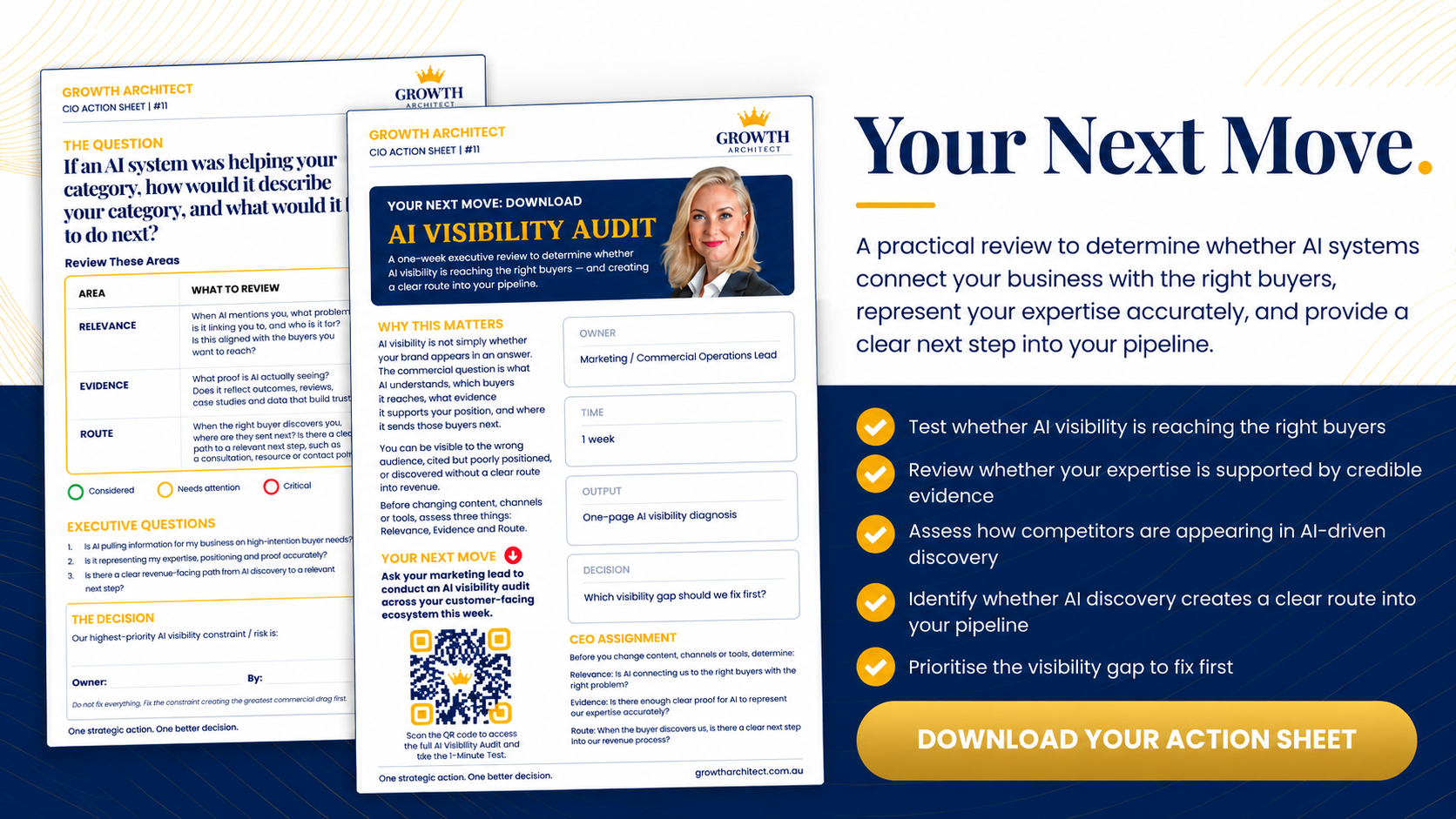
The Growth Architect AI Visibility Diagnostic is designed for this: a focused review of your current AI footprint, evidence layer and guardrails, tied directly to commercial impact.
If you want AI to describe your business the way your best salesperson would (accurately, credibly and in the right buyer context) make that diagnostic your next leadership conversation, not a backburner task.
About Rebecca Lloyd
Rebecca Lloyd is the founder of Growth Architect and a Fractional CMO who works with founder-led technology businesses on strategic marketing, GTM systems, executive authority and AI-enabled growth.
She works with CEOs and leadership teams to connect marketing strategy, AI implementation, sales pipeline visibility and commercial growth.
Rebecca is the creator of Growth Architecture, a strategic approach designed to connect CEO vision with the systems required for more predictable growth.
Her work sits at the intersection of growth strategy, go-to-market strategy, executive authority, marketing and AI-enabled commercial infrastructure.
Listen to Marketing Insights for Tech CEOs on Spotify