Strategic Marketing Strategy in 2026: Building for AI-Mediated Buying
Strategic Marketing Strategy in 2026: Building for AI-Mediated Buying
About Rebecca Lloyd
I'm Rebecca Lloyd, founder of Growth Architect and a Fractional CMO. I work with founder-led technology businesses on strategic marketing, GTM systems, executive authority and AI-enabled growth, connecting marketing strategy, AI implementation, sales pipeline visibility and commercial growth.
Executive Summary
A strategic marketing strategy in 2026 defines which customers your business prioritises, where you compete, how you differentiate and how marketing contributes to profitable growth. As AI increasingly influences how buyers discover, evaluate and compare suppliers, CEOs need to look beyond website traffic and campaign activity to understand whether their business is attracting the right buyers and generating qualified commercial opportunities. The AI Visibility Stack and Trust Stack help assess how clearly your business is represented, what evidence supports its positioning and whether buyers have sufficient confidence to take the next step. A focused 30–90-day review can identify gaps in positioning, measurement and execution before further marketing investment.
What Is a Strategic Marketing Strategy in 2026?
Before you approve next quarter's plan, ask yourself one question: are you looking at a strategy, or a schedule?
Most plans are schedules. They list channels, campaigns and content, and the leadership conversation stops at whether the activity is being delivered on time.
A strategic marketing strategy in 2026 is not a campaign calendar. It's the set of commercial decisions that determines where you compete, which customers you prioritise, how you differentiate, and how marketing contributes to profitable growth.
For an established technology business, those decisions now have to account for a different discovery environment. Your buyers combine conventional search, AI summaries and assistants, peer recommendations, industry research and procurement when they evaluate suppliers. The mix varies by market, but either way, website traffic alone gives you an incomplete view of demand.
The Pew Research Center put numbers on this shift. Its analysis of 900 US adults' browsing in March 2025 found users clicked a traditional result in 8% of Google visits with an AI summary, versus 15% without one, and links inside summaries were clicked in just 1% of visits. Although this is one market, one search engine and one period, and I wouldn't generalise it..its still noteworthy. Read the Pew Research Center findings.
My read: don't abandon SEO. But stop treating traffic as a proxy for demand, buyer understanding or revenue.
You might still rank on Google and report healthy top-of-funnel numbers. Those measures alone can't tell you whether the right buyers understand your position, whether your evidence supports your claims, or whether marketing is helping qualified opportunities progress!

In the rest of this article, I'll separate strategy from activity, look at what AI-mediated discovery is doing to buyer behaviour, and show you where I'd focus over the next 30–90 days.
What Makes a Marketing Strategy Effective in the AI Era?
A genuinely strategic strategy answers a harder question than “What will we do this year?”
It asks: How will we reliably create the right kind of demand, at the right margin, under the constraints and risks of our market?
Most plans duck that question.
The distinction becomes clearer when strategy is compared with activity.

A well-organised plan can still lack direction. More activity doesn't automatically create commercial value — sometimes it just makes the wrong positioning louder (and 'busier').
An effective strategy chooses:
→ Which customers to serve
→ Which problems to own
→ What evidence differentiates you, and
→ Which opportunities to walk away from.
It also connects marketing to the rest of the business. If sales is promising something delivery can't consistently provide, or marketing is attracting buyers who are a poor commercial fit, more leads make the problem worse, not better.
AI raises the stakes on alignment. Automation accelerates sound processes, and it amplifies unclear positioning, inconsistent information and broken handoffs just as efficiently.
How AI Is Changing Marketing Strategy and Buyer Behaviour
Here's where I'd focus if you brought me your numbers tomorrow: not on which AI tools your buyers use, but on whether they can answer three questions about you.
Can they work out why they should choose you?
Can you prove what you claim?
And can they assess whether you're the right fit against the alternatives that matter to them?
Entity. Trust. Fit. Those three decide most buying outcomes, and AI-mediated discovery hasn't changed that — it's just made the consequences of getting them wrong arrive faster.
The adoption data is genuinely murky. McKinsey's 2025 global survey found 62% of respondents' organisations were at least experimenting with AI agents, while 23% were scaling an agentic AI system somewhere in the enterprise — but most had not scaled AI broadly, and those figures describe organisational adoption, not how buyers choose suppliers. Read McKinsey's State of AI report. So prepare for new research behaviours without assuming every customer uses the same tools or buys the same way.
Google's own guidance makes the same point: its AI Search features still rely on foundational SEO, and there are no additional technical requirements or special AI optimisations needed to appear in AI Overviews or AI Mode. Its advice is to keep pages accessible to Search, publish helpful and reliable content, maintain internal links and make sure important information is available as text. Read Google's official guidance on AI features and your website.
So resist the urge to chase every new tactic. Get your positioning, information and evidence clear, then measure whether they're helping the right buyers decide.
The AI Visibility Stack
Entity, trust and fit are the three questions. When I assess whether a company answers them clearly enough for people and AI-assisted research tools to interpret, I use the AI Visibility Stack.
It has four components.

1. Entity clarity
Can a prospective customer quickly work out who you are, what you do and for whom?
Your positioning needs to be consistent across your website, leadership profiles, articles, service pages and case studies — the problems you solve, and the customers your solution is right for. If your content library is large but its articles send disconnected messages, it's working against you. Every important asset should reinforce the same market position.
2. Machine readability
Can people and digital systems readily interpret your key information?
I look for:
Clear headings and descriptive page titles.
Consistent terminology for your services, customers and problems.
Specific, RESULTS BASED, explanations of use cases, processes and limitations.
Comparison content that helps buyers understand meaningful differences.
Accessible case studies (again, PROBLEM & RESULTS BASED...not focussing on product) and evidence that support your claims.
These practices align with Google's Search guidance, including for AI features. They make your information more accessible and useful, but they don't guarantee a citation or recommendation.
3. Agent readiness
Could an AI-assisted research or purchasing workflow interpret your offer without tripping over ambiguous claims?
Review what your public information says about what you do, what you don't do, the assumptions behind your claims and the boundaries of your service. Where relevant, make governance, compliance and accountability information easy to find.
This won't guarantee a recommendation, but it strips out ambiguity and gives buyers something clearer to evaluate you on.
Safeguards matter too. McKinsey's 2025 survey found 51% of respondents at organisations using AI reported at least one negative consequence, including inaccuracy. It's a self-reported finding across AI broadly, not marketing alone, but it reinforces why accuracy and accountability belong in the operating strategy.
4. Benchmark fitness
Can a buyer compare you against meaningful selection criteria?
A case study gallery is a start, but buyers also need to understand:
Which problems you're best equipped to solve.
What outcomes you can substantiate.
Which trade-offs come with your approach.
How your offering fits their constraints and requirements.
Clear strengths, limitations and evidence help a buyer far more than generic claims.

If your information is unclear, adding more campaigns may increase activity without resolving the underlying positioning problem.
How to Recognise When Your Marketing Strategy Is Losing Relevance
A strategy can be losing relevance while every report still looks healthy. That's the trap.
The Strategy Decay Curve describes how it happens: a previously successful strategy loses relevance as platforms, buyer behaviour, competitors and business conditions change — while the campaigns keep running against assumptions that no longer hold.
The commercial cost isn't the spend on the campaigns. It's the decisions leadership makes on the strength of stale evidence.
Three warning signs:

Your content no longer reflects how buyers evaluate solutions. It answers broad informational questions but fails to address risk, implementation, procurement and commercial trade-offs.
Your reporting captures activity better than decisions. You know how many people visited a page, but you can't say whether the right buyers progressed.
Your systems conceal rather than solve friction. Automation sends the reminders and updates, but ownership, handoffs and approval processes remain unclear.
A customer-journey example
In one Growth Architect client engagement, we mapped approximately 18 customer touchpoints across coordinators, salespeople and project leads.
On paper, the process looked thorough. But once we looked at how the departments actually worked together, it became clear that critical handoffs and dependencies weren't always visible — procurement and access steps in particular. Projects could be delayed because of it.
So this wasn't a communication problem or an automation problem. The process didn't make dependencies and handoffs explicit.
The team focused on making cross-departmental handoffs visible, accounting for procurement and access requirements earlier, and identifying appropriate opportunities to discuss additional customer needs.
Before automating a customer journey, understand how it works.
Automation can support a sound process, but cannot resolve unclear ownership, commercial judgement or competing priorities on its own.
For a related perspective on the relationship between marketing, sales execution and automation, see SaaStr's discussion of whether to use an AI SDR before establishing a working human SDR motion.
Why Traffic Alone Is Not a Reliable Measure of Marketing Performance
The Pew findings explain why context matters: in that US browsing-data study, users were less likely to click traditional results when a Google AI summary appeared. The research doesn't show that all traffic is declining or prove revenue impact for any particular company. What it does show is that search-result experiences shape clicks.
Now connect that to your own numbers. If buyers are doing more of their evaluation before they ever reach your site, a flat-or-growing traffic line can hide a shrinking share of genuinely qualified demand. That's the commercial risk: not less traffic, but less of the traffic that was ever going to buy.
Four consequences I'd put in front of the board:
Margin pressure: if your differentiation is unclear, buyers compare you mainly on price or surface-level features, and discounting becomes the default lever.
Pipeline preparedness vs fragility: overreliance on a single acquisition channel leaves the business exposed the day that channel changes.
Misleading dashboards: sessions and page views can look healthy while the deals that actually close quietly thin out.
Operational blind spots: new tools get bolted onto individual marketing or sales activities while the customer-journey problems underneath stay untouched.

Traffic is one input to a marketing strategy, not the strategy itself. Your strategy has to show how relevant attention becomes trust, qualified demand and profitable customer relationships.
The Trust Stack: Your Advantage in an AI-Flooded Market
The AI Visibility Stack makes your information interpretable. It doesn't make it convincing. When every competitor can produce competent content on demand, the thing buyers fall back on is your point of view and the evidence behind it.
The Trust Stack examines those signals.

Layer 1: Branded demand
Do potential customers seek out your company by name, or do they encounter you only when searching for a general solution?
Branded demand can indicate recall and association with a problem or perspective, but it is not proof of trust on its own.
Layer 2: Founder and leadership point of view
Generic content is easy to reproduce. The decisions, experiences and trade-offs that shaped your leadership team's thinking aren't.
Make that perspective visible through:
Clear positions on the problems and risks facing your market.
Articles and videos that explain how your team thinks.
Specific lessons from real decisions, including what didn't work.
Evidence showing where your approach works, and where it doesn't.
A distinct point of view lets buyers understand how you think before the first meeting. That's what a founder's credibility is built on — and it's the hardest signal for a competitor to copy.
The Growth Architect sniper campaign case study shows it in action: a personalised executive video addressing a specific commercial problem did what months of conventional outreach couldn't. The lesson isn't "make videos". It's that visible, specific expertise changes who responds to you.
Layer 3: Accountability and governance
Trust is built on clear information, not vague promises.
Depending on your business, that can include:
Clear explanations of service scope and limitations.
Relevant policies and compliance information.
Transparent descriptions of how AI is used.
Evidence supporting claims about results and capabilities.
A clear process for accountability when something goes wrong.
The 2025 McKinsey survey found that reported AI-related negative consequences included inaccuracy, among other risks. The survey wasn't limited to marketing, but the reminder stands: bringing AI into business processes means owning reliability and risk, not just speed.
For a separate AI reliability incident, see TechCrunch's reporting on an Anthropic AI model sending a false homicide tip to Philadelphia police. Treat it as an illustration of what unreliable AI outputs can cause, not as evidence of how often this happens.
Trust is not just a brand perception. It must be supported by evidence, consistent information and accountable business practices.
Which Marketing Metrics Matter When Buyers Use AI?
You need measures that change decisions, not just numbers that are easy to collect.
Traffic, rankings and engagement still have their place, but read them alongside buyer quality, sales progression and customer outcomes.
Metrics that need context
Raw traffic: Segment it by audience, intent and relevance rather than treating every visit as equally valuable.
Social reach: Examine whether reach leads to meaningful engagement with the people you want to serve.
Content volume: Assess whether new content strengthens your market position or repeats existing material.
Automation activity: Measure what happens after an email, workflow or sequence runs, not only whether it ran.
Metrics worth adding to the boardroom
Problem-path coverage: For your three to five priority customer problems, how many important buyer questions have clear, useful answers?
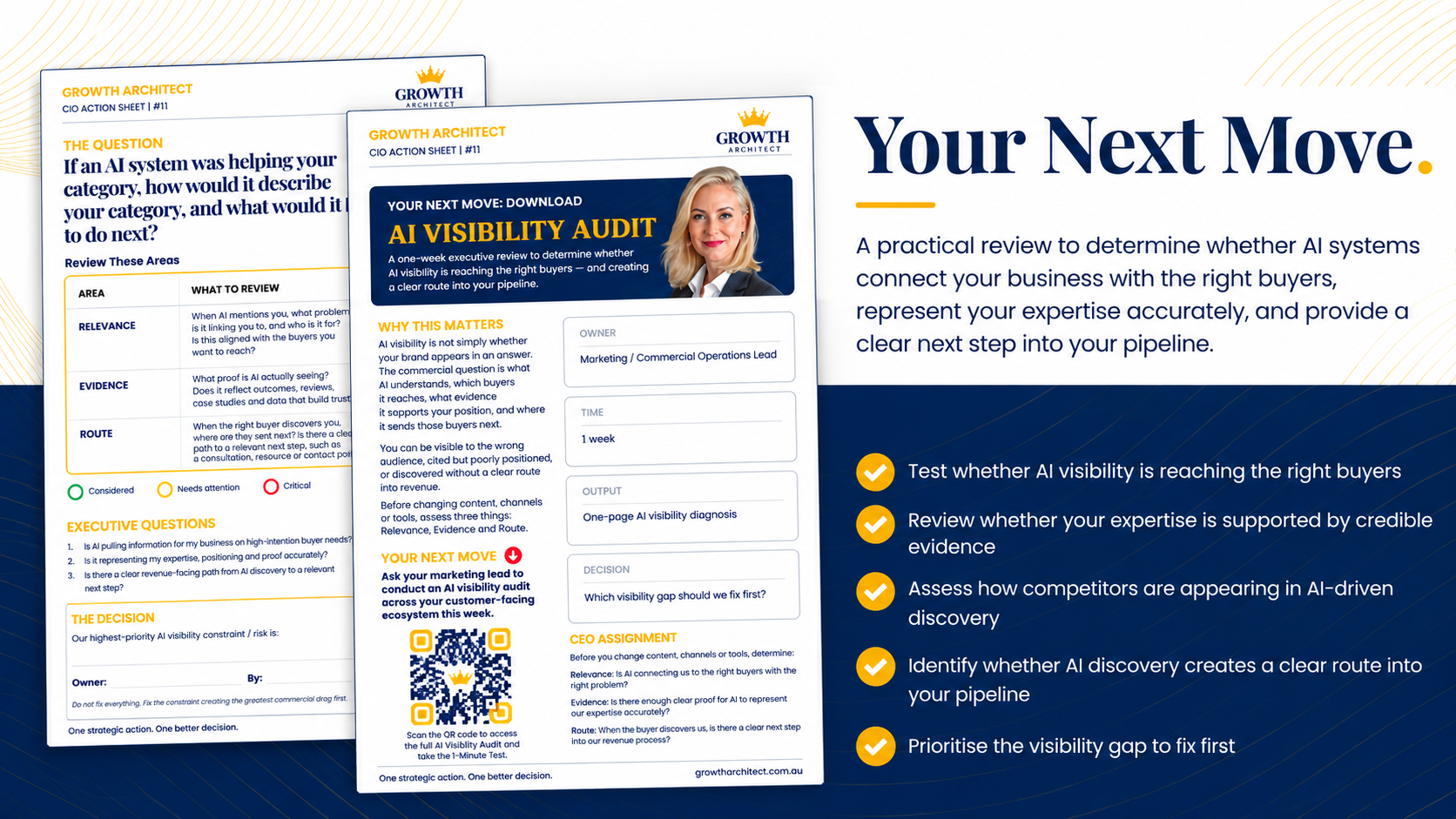
AI visibility checks: When you test relevant questions in selected AI tools, does your business appear? Is the information accurate? Are competitors or other sources more visible? Record the tool, prompt, date and results, because these observations can vary.
Qualified conversation rate: What proportion of enquiries or interactions leads to conversations with buyers who match your target profile?
Time to human: How quickly can a qualified buyer reach the right person when human judgement is needed?
Commercial progression: How are qualified opportunities progressing through the pipeline? Examine conversion rates, sales-cycle length, deal quality and margin where the data is available.
Customer outcomes: Are customers achieving the outcomes promised, and what does that reveal about positioning, onboarding, delivery and retention?
No single metric tells the whole story. Together, they connect marketing performance with buying behaviour and delivered value.
For an example of how AI systems can produce inaccurate or unsupported citations, review Search Engine Journal's reporting on Claude and fake sources in AI answers. The practical lesson is to verify AI-generated claims against original sources rather than treating a confident answer as evidence.
AI Should Assist Your Strategy, Not Write It
AI can research markets, analyse information, produce drafts, test variations and support repeatable workflows. All useful. None of it decides which customers you serve, which trade-offs you accept, or what happens when automation and your positioning disagree — those decisions are still yours, and they're the ones with margin attached.
McKinsey's 2025 research found most surveyed organisations hadn't scaled AI enterprise-wide, despite broad experimentation, and points to workflow redesign as a key factor in capturing value. Read that as a test: evaluate AI by how well it improves a business process, not by how many tools you deploy.
Start with a cross-functional meeting involving sales, marketing and, where possible, delivery.
The meeting that tests whether your strategy is real
1. Start with customer problems, not products.
Choose your top three customer problems. Map the questions buyers ask from initial concern through research, selection and implementation.
2. Compare the journey with your existing content and processes.
Identify where you provide clear answers and where customers encounter gaps, contradictions or unsupported claims.
3. Expose cross-departmental friction.
Ask sales where qualified deals stall. Ask delivery where projects slow down. Ask marketing where the message becomes unclear or attracts the wrong audience.
4. Decide where AI can help.
Identify suitable uses such as routing, knowledge retrieval, FAQs and routine documentation. Specify where human review is needed for qualification, pricing, contracts, risk or sensitive customer relationships.
5. Define your non-negotiables.
Agree on the customer experience, quality standards, accountability requirements and leadership involvement that must not be sacrificed for speed.
The goal is not to automate everything, but to improve the journey while protecting business-critical judgement, relationships and standards.
How to Assess Whether Your Marketing Strategy Is Ready for AI-Mediated Buying
Use these questions as a working diagnostic. The point is to expose gaps — not to score yourself into false confidence about AI visibility.
Entity and visibility
Can you explain in one paragraph whom you serve, what you do and why your approach is distinct?
When you test relevant buyer questions in selected AI tools, is your business represented accurately?
Does your content reinforce a coherent market position?
Trust and governance
Is your leadership point of view visible in your marketing?
Can buyers verify important claims through accessible evidence?
Are your limitations, service boundaries and relevant governance information clear?
Journey architecture
Have sales, marketing and delivery mapped the customer journey together in the last 6–12 months?
Can you identify where deals or projects most often stall?
Are handoffs and responsibilities explicit?
Do you understand where additional customer needs can be addressed appropriately?
AI's role
Have you defined which tasks AI can support and which decisions require human judgement?
Can qualified buyers reach a person when needed?
Are your AI-supported processes being assessed against customer experience and commercial outcomes?
If several answers are unclear, treat that as a reason to investigate. It doesn't automatically mean your strategy is failing, but it identifies assumptions that deserve testing.
How to Adapt Your Marketing Strategy Over the Next 30–90 Days
You don't need to discard existing campaigns. Start with the gaps most likely to affect target customers and commercial priorities.

Step 1: Audit content against buyer problems
Select your top three customer problems. For each one:
List the questions buyers ask from initial research through approval and implementation.
Identify the pages, articles, case studies and other assets that answer those questions.
Flag gaps involving risk, implementation, return on investment, alternatives and trade-offs.
Check whether claims are supported by evidence.
Test selected questions in relevant AI tools and record what you observe. Treat the results as a dated snapshot, not a permanent ranking.
Step 2: Strengthen your AI Visibility Stack
Clarify your positioning: Use consistent language about your customers, services and priority problems.
Improve information structure: Make key pages easy to navigate and understand.
Publish useful evidence: Develop relevant case studies, FAQs and explanations of your processes and limitations.
Support comparison: Help buyers understand your fit, strengths and trade-offs without making unsupported superiority claims.
Step 3: Re-architect the customer journey
Bring sales, marketing and delivery into the same conversation.
Map where the journey slows down, where handoffs are assumed rather than explicit, and where automation might be concealing a structural problem.
Then prioritise changes that improve customer experience and commercial value. Remove unnecessary steps, clarify ownership and define appropriate opportunities for follow-up or additional services.
Step 4: Define AI's role precisely
For each journey stage, decide what AI can own, where it can assist and where it must not make the final decision.
AI might retrieve approved information or route an enquiry. Decisions involving complex risk, commercial negotiation, sensitive information or significant commitments require human review.
Document those boundaries as part of the operating strategy rather than leaving them inside a separate technology project.
Step 5: Establish review triggers
A strategy should change when its underlying assumptions change. Agree on which signals trigger a review: a sustained decline in qualified opportunities, a shift in buyer requirements, deteriorating conversion rates, or evidence that your content no longer answers important customer questions.
Set a regular review involving sales, marketing and delivery. Assess new AI capabilities against the same commercial objectives, customer standards and governance requirements.
The goal is not to predict every market change, but to build a strategy that recognises and responds to change.
What a 2026-Ready Strategic Marketing Strategy Really Does
An effective strategic marketing strategy in 2026 does five things:
Starts with customer problems and commercial outcomes rather than channels and activity.
Makes the company's position and evidence clear to buyers and digital research systems.
Treats trust, accountability and proof as operating requirements.
Uses AI to support execution without outsourcing leadership judgement.
Connects marketing, sales and delivery so the customer journey works as a whole.
A campaign calendar can organise activity. A strategy explains why that activity matters, whom it serves, how success is measured, and what the business will change when the evidence says it isn't working.

Static strategies are comfortable. Living strategies are commercial.
Frequently Asked Questions
What is a strategic marketing strategy?
A strategic marketing strategy defines which customers a business will prioritise, the problems it will solve, how it will differentiate itself, and how its marketing decisions contribute to commercial outcomes. It guides campaigns and channel choices rather than simply listing them.
How is AI changing marketing strategy?
AI is changing how teams research, create and distribute information, and AI-assisted tools can influence how some buyers explore and compare solutions. Assess these changes in your own market, strengthen the clarity and evidence of your positioning, and connect marketing measures to qualified demand and customer outcomes.
What is AI visibility in marketing?
AI visibility describes whether and how a business, its products or its expertise appear in responses generated by relevant AI tools. Results vary by platform, prompt and time, so visibility checks are useful diagnostics — not guarantees of recommendation or revenue.
Is SEO still important when buyers use AI?
Yes. Google states that foundational SEO practices remain relevant to its AI Search features and that no special AI optimisation is required for inclusion in AI Overviews or AI Mode. Keep creating helpful content, maintain accessible pages and internal links, and measure the commercial value of your visibility.
Which marketing metrics matter most in 2026?
It depends on your business model and goals. Useful measures include qualified conversation rate, pipeline progression, sales-cycle length, margin, customer outcomes and buyer-question coverage. Traffic and engagement can explain performance, but they shouldn't replace commercial measures.
How can a CEO improve a marketing strategy in 90 days?
Start by selecting your priority customer problems and auditing the content and evidence behind each. Then address positioning and information gaps, map the customer journey with sales and delivery, define where AI helps and where it doesn't, and establish regular reviews tied to commercial outcomes.
Put Your Strategy Under an AI-Era Diagnostic
Before you commit more budget to marketing, I'd want to understand what's actually constraining growth — and whether your current reporting is even measuring it.
That's what we investigate through the Growth Architect GTM Diagnostic: where your strategy, positioning and customer journey are supporting growth, and where they're getting in the way.
If your current strategy raises uncomfortable questions, the objective is to turn them into a clear, prioritised plan for what to investigate and improve next.
Author: Rebecca Lloyd, founder of Growth Architect and Fractional CMO to founder-led technology businesses.